Production principle
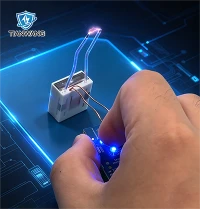
The circuit device can output a high voltage pulse of nearly ten thousand volts for self-defense. The whole device is made into the form of a flashlight, which is dual-purpose.
Circuit principle: BG1, BG2, B1 form AC and DC converters, and B1 is boosted to charge C2 through QL bridge rectification. BG3 and BG4 form a multivibrator with a large hollow coefficient, which outputs pulses to trigger the thyristor 3CT5 to turn on. The capacitor C2 is discharged through the primary of 3CT5 and B2, B3, and B4. Therefore, each secondary of B2, B3, and B4 is connected in series to output a high voltage of nearly ten thousand volts. When the function selection switch K is set to 1 position, it is used as a lighting flashlight.
Make components
Transformer B1 uses a medium wave magnetic rod to cut two sections of 20mm and 30mm each. After winding the coil, use epoxy resin glue to form a mouth-shaped magnetic ring. The data of each winding is shown in the note. It is better to use E11 cores. B2, B3, and B4 use commercially available XD type 380V/6.3V indicator transformers. The primary and secondary are used in reverse. The original 6.3V secondary is connected in parallel as the primary, and the original 380V primary is connected in series as the secondary. When connecting, pay attention to the series connection of the secondary potentials, otherwise the output voltage will be insufficient. The β value of BG1 and BG2 should be greater than 60, and the performance should be as close as possible.
Debugging: first adjust the DC-AC converter so that the B1 secondary voltage is above 200V, and should not be less than 160V when connected to a 39k load. After the whole machine is connected, the ZD flashes, and the high-voltage pulse transformer makes a "pop, pop" sound. Connect the voltmeter between the anode and cathode of the thyristor, and the maximum swing of the meter should be close to 150V. The oscillation period of the multivibrator should be synchronized with the C2 charging period, that is, the pulse of the multivibrator should trigger the thyristor when C2 is fully charged. This can be achieved by repeatedly adjusting the values of R2, C2, and C3 so as to synchronize as much as possible to obtain the best output. After adjustment, the high-voltage pulse frequency is between 60-120 times per minute.