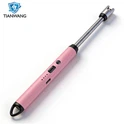
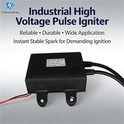
The so-called pulse igniter, or pulser for short, is an electronic product that uses the principle of pulse to generate a continuous instant electric spark to ignite the flame of a gas appliance.
With the improvement of industrial technology, the production cost of the pulser has been reduced, and it has been widely applied to high-end gas appliances, which greatly facilitates the use of customers and improves the level of product automation.
Pulse igniter is a device that uses high-voltage electric sparks to ignite the combustible gas in the stove. The input working voltage can be divided into DC 1.5V, 3V, 6V, 9V, etc. and AC 120V, 240V, etc. According to its input working voltage, it can be divided into DC 1.5V, 3V, 6V, 9V and so on. According to its output function, it can be divided into one to eight output terminals.

The pulse igniter T1, BG, and R form an oscillating booster circuit, which increases the 1.5V direct current to about 400V alternating current. After rectification by D, it goes to C1. When the voltage at both ends of C1 rises to a certain value, the BG2 tube suddenly searches If the switch is turned on, the internal resistance is very small. At this time, C1 passes through, and the primary coil of T2 discharges. The discharge time is very short and the current is large. Therefore, the secondary of T should have a very high voltage, ( Up to 15-30KV) Spark discharge can be generated between its two leading heads.
In addition, when BG2 is found, the secondary T1 is equivalent to a short circuit, and BG1 stops oscillating. When C1 is discharged, BG2 returns to the disconnected state. BG1 immediately starts to oscillate and boost again, repeating the aforementioned working process, so the electric spark produced is a continuous spark with a certain intermittent. The discharge frequency is about 2.5-12 times per second.