As a seasoned supplier of high voltage coils, I've witnessed firsthand the intricate relationship between the number of turns in a coil and its overall performance. High voltage coils are essential components in a wide range of applications, from ignition systems to ozone generators and pulse transformers. Understanding how the number of turns affects their performance is crucial for both manufacturers and end - users.
The Basics of High Voltage Coils
Before delving into the impact of the number of turns, let's briefly review the fundamental principles of high voltage coils. A high voltage coil is essentially an electromagnetic device that uses the principle of electromagnetic induction to convert electrical energy from a low - voltage source to a high - voltage output. It typically consists of a primary coil and a secondary coil wound around a magnetic core.
When an alternating current (AC) is applied to the primary coil, it creates a changing magnetic field in the core. This changing magnetic field then induces an electromotive force (EMF) in the secondary coil according to Faraday's law of electromagnetic induction. The ratio of the number of turns in the secondary coil to the number of turns in the primary coil determines the voltage transformation ratio of the coil. Mathematically, it can be expressed as:
[ \frac{V_s}{V_p}=\frac{N_s}{N_p} ]
where (V_s) is the secondary voltage, (V_p) is the primary voltage, (N_s) is the number of turns in the secondary coil, and (N_p) is the number of turns in the primary coil.
Impact on Voltage Output
One of the most direct effects of the number of turns on a high voltage coil is its impact on the voltage output. As the formula above indicates, increasing the number of turns in the secondary coil relative to the primary coil will result in a higher secondary voltage. This is because a larger number of turns in the secondary coil will intercept more magnetic flux lines from the changing magnetic field, thus inducing a greater EMF.
For example, in applications such as the High Voltage Transformer For Ignition System, a high voltage is required to generate a spark for igniting the fuel - air mixture in an engine. By increasing the number of turns in the secondary coil of the ignition coil, we can achieve the high voltage necessary for reliable ignition.
However, there are practical limitations to increasing the number of turns. As the number of turns increases, so does the resistance of the coil. This increased resistance can lead to power losses in the form of heat, reducing the overall efficiency of the coil. Additionally, a large number of turns may also increase the capacitance between the turns, which can cause issues such as voltage breakdown and electromagnetic interference (EMI).


Influence on Inductance
The number of turns also has a significant impact on the inductance of the coil. Inductance is a measure of a coil's ability to store energy in a magnetic field when an electric current is flowing through it. The inductance of a coil is proportional to the square of the number of turns. Mathematically, it can be expressed as:
[ L = \frac{\mu N^{2}A}{l} ]
where (L) is the inductance, (\mu) is the permeability of the core material, (N) is the number of turns, (A) is the cross - sectional area of the coil, and (l) is the length of the coil.
An increase in inductance can have several effects on the performance of the high voltage coil. Firstly, it affects the time constant of the coil, which is related to how quickly the current in the coil can change. A higher inductance means a longer time constant, which can slow down the response time of the coil. This can be a critical factor in applications such as the 8 Slot 4 - pin Pulse Transformer High Voltage Package Booster Coil, where fast - rising pulses are required.
Secondly, a high - inductance coil can store more energy in its magnetic field. This stored energy can be useful in applications where a large amount of energy needs to be released quickly, such as in some types of high - voltage discharge circuits. However, it also means that more energy is required to establish the current in the coil, which can increase the power consumption and the stress on the power supply.
Effect on Magnetic Field Strength
The number of turns directly impacts the magnetic field strength generated by the coil. According to Ampere's law, the magnetic field strength ((H)) inside a solenoid (a type of coil) is given by:
[ H=\frac{NI}{l} ]
where (N) is the number of turns, (I) is the current flowing through the coil, and (l) is the length of the coil.
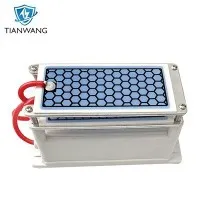
As the number of turns increases, for a given current, the magnetic field strength inside the coil also increases. A stronger magnetic field can enhance the coupling between the primary and secondary coils, improving the efficiency of the voltage transformation. In applications like the High Voltage Coil Of Ozone Generator, a strong magnetic field is often required to generate the high voltage needed for ozone production.
However, a very strong magnetic field can also cause saturation of the magnetic core. When the core saturates, its permeability decreases, which can lead to a reduction in the inductance of the coil and an increase in the magnetizing current. This can result in increased power losses and reduced performance of the high voltage coil.
Considerations for Different Applications
Different applications have different requirements for high voltage coils, and the number of turns needs to be carefully selected to meet these requirements.
In ignition systems, a high voltage is needed to create a spark across the spark plug gap. The number of turns in the secondary coil is typically large to achieve the required high voltage. However, the coil also needs to have a relatively fast response time to ensure timely ignition. Therefore, the design must balance the need for high voltage with the need for a reasonable inductance and resistance.
For pulse transformers, fast - rising and well - defined pulses are essential. A lower number of turns may be preferred to reduce the inductance and capacitance of the coil, allowing for faster signal propagation. However, the voltage transformation ratio still needs to be maintained to achieve the desired high - voltage output.
In ozone generators, a high and stable voltage is required to generate ozone efficiently. The number of turns is selected to produce a high enough magnetic field and voltage while ensuring that the core does not saturate. The coil also needs to be designed to withstand the high - voltage stress and the chemical environment associated with ozone production.
Conclusion
In summary, the number of turns in a high voltage coil has a profound impact on its performance, including voltage output, inductance, magnetic field strength, and response time. As a high voltage coil supplier, we understand the importance of optimizing the number of turns for different applications. By carefully considering the specific requirements of each application and balancing the various factors, we can design and manufacture high - quality high voltage coils that meet or exceed our customers' expectations.
If you are in need of high - voltage coils for your specific application and want to discuss the optimal number of turns and design considerations, we invite you to reach out to us for procurement and in - depth technical discussions.
References
- Grover, F. W. (1946). Inductance Calculations: Working Formulas and Tables. Dover Publications.
- Marcus, S. M. (2007). High - Voltage Engineering and Testing. IEEE Press.
- Sadiku, M. N. O. (2014). Elements of Electromagnetics. Oxford University Press.