Introduction
If you fly gasoline‑powered model aircraft or small UAVs, you have likely heard the term "automatic advance" mentioned in forums and product listings. But what does it actually mean? And why should it influence your choice of a CDI ignition for your two‑stroke engine?
This guide explains the science behind ignition timing, outlines why fixed‑advance igniters fall short, and demonstrates how an automatic advance igniter – such as the TW‑G‑DHQ from Jiangsu Tianwang Solar Technology Co., Ltd – can significantly improve your flying experience.
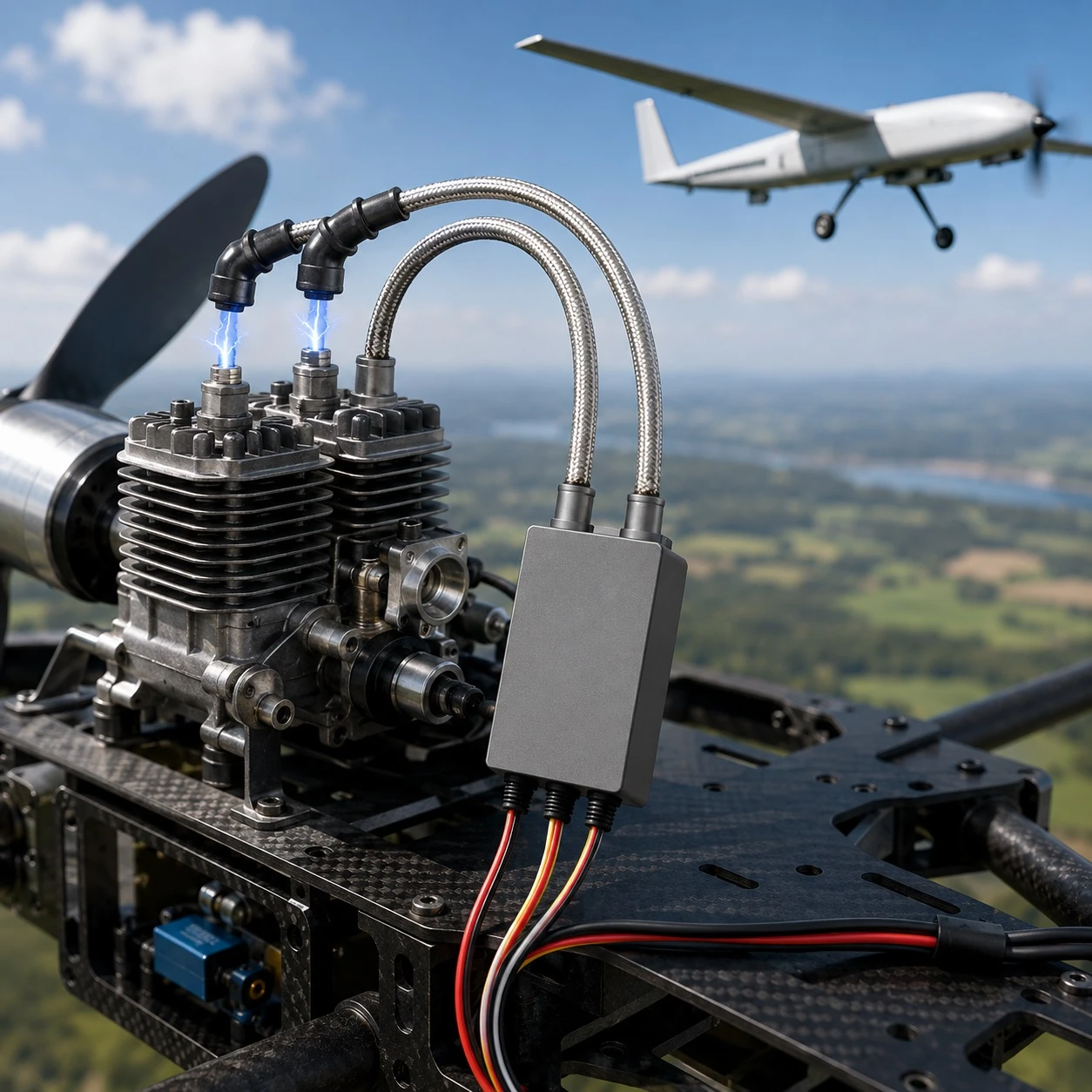
The Basics: What Is Ignition Timing?
In any internal combustion engine, the spark plug must fire at precisely the right moment to ignite the air‑fuel mixture. This moment is measured in degrees before top dead centre (BTDC) – the position of the piston before it reaches the highest point of its stroke.
For a two‑stroke model engine, the ideal ignition point changes continuously with engine speed:
At idle (around 800 RPM), the mixture burns relatively slowly, so the spark should occur later (closer to TDC) to avoid opposing the rising piston.
At high RPM (up to 7200 RPM), the mixture moves faster and requires earlier ignition – the spark must be advanced so that peak combustion pressure occurs exactly when it delivers maximum torque.
A typical advance curve starts at approximately 10° BTDC at idle and reaches 30°–35° BTDC at full throttle. This is not a fixed number – it must be dynamically adjusted to suit real‑time operating conditions.
The Problem with Fixed‑Advance Igniters
Older and simpler CDI modules – and many basic igniters for two‑stroke engines – use a fixed advance angle. They discharge the spark at the same BTDC value regardless of engine speed. This creates two serious drawbacks:
At low RPM, the spark fires too early, causing the engine to work against its own compression – leading to rough idling, hesitation, and even kickback that can damage the starter mechanism.
At high RPM, the spark fires too late, as the mixture lacks sufficient time for complete combustion – resulting in power loss, excessive heat, and potentially destructive detonation (knock).
In short, a fixed‑advance igniter forces a compromise: you can tune it for good top‑end power, but low‑speed running will suffer – or vice versa.
How Automatic Advance Solves This
An automatic advance CDI igniter eliminates this compromise. It incorporates a microcontroller that monitors the engine's RPM in real time and continuously recalculates the optimal ignition angle. This functionality is often referred to as electronic advance or adaptive timing.
The operating sequence is as follows:
The igniter receives a trigger signal from a magnetic pickup or Hall sensor mounted near the flywheel.
Based on the time interval between successive pulses, it calculates the current RPM.
It then refers to a pre‑programmed advance curve (or applies a mathematical algorithm) to determine the exact firing angle.
At the precise moment, it discharges the capacitor to generate the spark.
All of these operations occur in microseconds. The result is that your two‑stroke UAV engine always receives the spark at the optimal point – whether you are taxiing, hovering, or flying at full throttle.
Real‑World Benefits of an Automatic Advance Igniter
Switching from a fixed‑advance unit to a quality automatic advance igniter – such as the TW‑G‑DHQ – delivers observable improvements across all flight phases:
| Aspect | With Fixed Advance | With Automatic Advance |
|---|---|---|
| Starting | Often requires forceful flipping; risk of kickback | Smooth and effortless starts – reduced strain on starter |
| Idling | Rough, prone to stalling | Stable and reliable idle – even at low RPM |
| Throttle response | Sluggish off‑idle with occasional bogging | Crisp and instantaneous pick‑up |
| High‑end power | Drops above mid‑range; engine runs hot | Consistent pull throughout the RPM band; cooler operation |
| Fuel efficiency | Incomplete combustion wastes fuel | Better mileage – extended flight endurance for small UAV missions |
| Engine longevity | Increased wear from detonation and heat | Lower mechanical stress – extended service life |
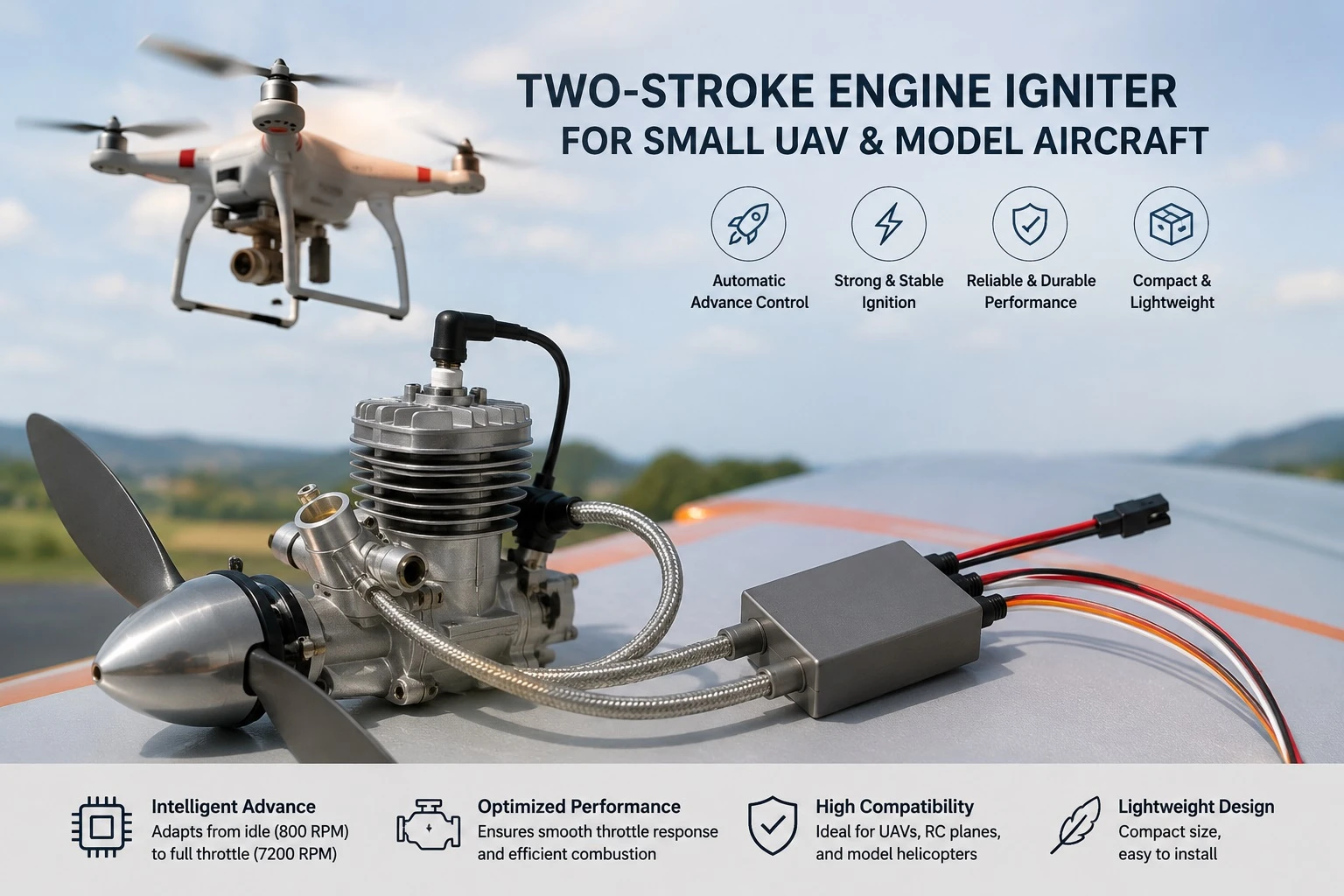
Why Two‑Stroke Engines Benefit Even More
Two‑stroke engines are inherently more sensitive to ignition timing than their four‑stroke counterparts. They fire every revolution, have narrower power bands, and rely heavily on proper scavenging and combustion phasing. An incorrect advance angle can cause severe overheating or pre‑ignition – both frequent failure modes in air‑cooled model engines.
That is why the TW‑G‑DHQ is purpose‑built as a two‑stroke engine igniter. Its advance curve is specifically calibrated to the typical characteristics of small gasoline two‑strokes used in UAVs, ensuring an optimal match for engines ranging from 10cc to 35cc and beyond.
What to Look for in a Quality Automatic Advance CDI
When selecting an automatic advance CDI for your drone or model aircraft, consider the following specifications:
Wide voltage input – The igniter should accept 6V–14.4V (2S‑4S Li‑Po) without the need for external regulators.
High output voltage – ≥18kV ensures a robust spark even in cold, humid, or high‑altitude conditions.
Full RPM coverage – A range covering idle to redline (e.g., 800–7200 RPM) is essential.
Temperature tolerance – The unit should operate reliably from -20°C to +60°C for year‑round outdoor flying.
Robust encapsulation – Full epoxy potting resists vibration, oil, and moisture – a critical requirement for UAV applications.
The TW‑G‑DHQ meets all of these criteria. It is compact (51.4×39.4×29.2 mm), lightweight, and engineered specifically for the demanding environment of small UAV operations.
Common Misconceptions
"Automatic advance is only for high‑performance racers."
False. Even a sport‑flying model benefits from smoother idling and improved throttle response. Better fuel economy also translates into longer endurance for FPV or surveying missions.
"I can adjust the timing by rotating the sensor."
Rotating the sensor changes the base timing but does not create a dynamic curve – you still have a fixed advance, just with a different offset.
"CDI is CDI – they are all the same."
Not at all. Basic CDI units often use fixed angles or crude advance curves. A proper automatic advance igniter employs a microcontroller and precisely mapped timing curves, making a substantial difference in real‑world performance.
Frequently Asked Questions (FAQ)
Q: Which engines are compatible with the TW‑G‑DHQ igniter?
A: It is designed for single‑cylinder gasoline two‑stroke model engines operating in the 800–7200 RPM range – the standard for the majority of small UAV powerplants.
Q: What power supply is required?
A: The igniter accepts DC 6V–14.4V, allowing direct connection to common 2S–4S Li‑Po batteries or BEC regulators without additional voltage conversion.
Q: How does automatic advance improve engine durability?
A: By optimising ignition timing across the entire RPM range, it reduces detonation and excessive cylinder temperatures – two leading causes of wear in air‑cooled two‑stroke engines.
Q: Is the TW‑G‑DHQ suitable for multi‑rotor UAVs?
A: Yes. Its compact form factor and wide voltage tolerance make it suitable for small gasoline‑powered multi‑rotors, as well as fixed‑wing and scale models.
Final Verdict
If you are currently using a fixed‑advance igniter on your gasoline two‑stroke model engine, you are leaving performance potential untapped – and increasing the risk of operational issues. Upgrading to an automatic advance CDI like the TW‑G‑DHQ is one of the most cost‑effective improvements you can make.
You will notice:
Easier starting
Smoother idle
Crisper throttle response
More power across the entire RPM spectrum
Cooler operation and extended engine lifespan
For small UAV operators – whether you fly fixed‑wing, multi‑rotor, or scale warbirds – an automatic advance two‑stroke igniter is not merely an enhancement; it is a foundation for consistent, dependable flight.
About the Product
The TW‑G‑DHQ Automatic Advance Igniter is manufactured by Jiangsu Tianwang Solar Technology Co., Ltd. It serves as a direct replacement for most standard CDI modules, with plug‑and‑play wiring (input lead: 150mm; high‑tension lead: 400mm). It accepts 6–14.4V DC, delivers ≥18kV spark energy, and operates reliably across a temperature range of -20°C to +60°C.
Whether you are upgrading an existing model or building a new UAV, this automatic advance CDI provides the performance edge you need.
Get in Touch
For technical inquiries, customisation requests, or bulk orders, please contact our sales team via the website or email us at fgd@twgdmall.com. We are happy to assist with integration questions and provide application‑specific advice.