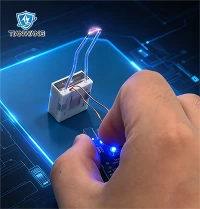
When the gifts of nature face challenges, how can technology continue the cycle of life? During the flowering season, bees' pollination efforts are often hampered by adverse weather conditions. To ensure that flowers can successfully bear fruit, we have combined innovative technology with natural wisdom to develop a revolutionary pollination technique-Aerodynamic Electrostatic Spraying.
This electrostatic artificial pollination technology simulates the natural pollination process, using electrostatic principles to enhance pollination efficiency and crop yield. Compared to traditional bee-dependent pollination, our technology demonstrates unparalleled efficiency and adaptability. Electrostatic pollination, unhindered by wind or rain, can be performed in any weather conditions, achieving more uniform and extensive coverage, particularly in vast farmlands or orchards, significantly boosting yields.
At the core of the Aerodynamic Electrostatic Spraying process is the utilization of electrostatic power supply generated by high-voltage sources. We precisely control pollen particles, fine as dust, to about 60 microns in size. Under the influence of an electric field, these charged pollen particles adhere evenly to tiny water droplets. As the spray disperses, these pollen-laden droplets gently cover the receptive stigmas of flowers, greatly improving pollination efficiency and ensuring stability in adverse weather conditions. The clever application of electrostatic force not only reduces pollen wastage but also mitigates environmental impacts on the pollination process.

In this era where technology and nature converge, we continuously explore to protect the marvels of nature with the power of technology. The Aerodynamic Electrostatic Spraying process is not only a profound tribute to traditional pollination methods but also a commitment to sustainable agricultural development. Together, let's harness technology to witness the prosperity and vitality of nature.
Example: Apple Orchards Apple trees require pollination to bear fruit. Traditionally, we rely on bees and other insects to transfer pollen from the stamens of one flower to the pistils of another. However, in adverse weather conditions, such as rain or strong winds, bees may not effectively pollinate.
To address this issue, we introduced electrostatic artificial pollination technology. We collect pollen from the male flowers or anthers of apple trees and clean and dry it. The treated pollen is then loaded into a specialized electrostatic sprayer, connected to a high-voltage power supply to generate an electrostatic field.
When the sprayer operates, the electrostatic field created by the high-voltage source charges the pollen particles positively. The charged pollen particles are expelled from the nozzle as tiny water droplets. Due to the repulsion of like charges, the droplets are atomized into very fine particles.
These positively charged pollen particles are attracted to the negatively charged stigmas of apple tree flowers, as opposite charges attract. Under the influence of electrostatic force, the charged pollen particles precisely deposit on the flower stigmas, achieving efficient pollination.
Through this example, we can see how electrostatic artificial pollination technology uses electrostatic principles to charge pollen particles and accurately deposit them on flower stigmas, thereby improving pollination efficiency and crop yield. This method can be performed under adverse weather conditions, reducing dependence on natural pollinators and enhancing crop yield and quality.