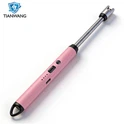
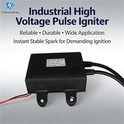
The ignition of gas stoves generally uses electric spark ignition, and the ignition devices mainly include piezoelectric ceramic igniters and pulse igniters.

The piezoelectric ceramic igniter has compact structure, simple process and low cost. Piezoelectric ceramic igniter is composed of piezoelectric ceramic element, ignition hammer, spring, ignition needle, high-voltage wire, switch, ignition nozzle; grounding discharge terminal and rotary switch.
The pulse igniter uses dry battery as power source, and its electronic components use a transistor as an oscillating element or an integrated block as an oscillating element; it also includes a pulse switch, a burner hole, an ignition needle, a high-voltage line, and a ground discharge terminal, which are composed of a pulse high frequency In the oscillator, the high frequency voltage generated by the oscillator is stepped up to high voltage of 15KV by a step up transformer, and the tip discharge is performed, and the gas on the burner is ignited by the spark of the discharge. Press the knob, the pulse igniter starts to ignite; loosen the knob, the pulse stops ignition.

The piezoelectric ceramic igniter has the advantages of long life, no other power supply, and can work normally in humid and high-heat conditions. The disadvantage is that only one spark can be produced at a time. The pulse igniter has the advantages of continuous discharge during ignition, high ignition rate, time-saving and labor-saving, safe and reliable. Pulse igniters can be used for direct ignition of gas fuel and liquid fuel burners, no other auxiliary ignition means are needed, and are widely used in open flame ignition of gas fuel or liquid fuel burners in various water heater industrial furnaces. The disadvantage is that it is easy to damage after being damp; it must be kept clean and dry; the ignition spark will become smaller and the battery must be replaced; the battery must be taken out if the stove is not used for a long time.