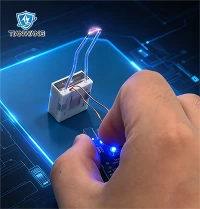
EE57 Electric Fence Transformer Manufacturer | 16kV High Voltage Pulse Transformer with Vacuum Epoxy Potting
The TW-G-EE57 Electric Fence Transformer is a high-voltage pulse transformer designed for electric fence energizers and perimeter security systems. Manufactured with a standard EE57 ferrite core and a two-stage vacuum epoxy potting process, this high voltage pulse transformer provides reliable electrical insulation, stable winding parameters, and customizable performance for different energizer circuit designs.
Developed and manufactured by Jiangsu Tianwang Solar Technology Co., Ltd., the TW-G-EE57 features a rated body withstand voltage of 16 kV, epoxy insulation strength of 30 kV/mm, and a centre-tapped secondary winding with 800 turns in total.
As an experienced electric fence transformer manufacturer, Tianwang offers both standalone transformer components and complete electric fence energizer units. OEM and ODM services are available, including customized input voltage, winding parameters, pulse energy, lead length, and housing structure.
Whether you are an electric fence energizer manufacturer, security system integrator, or wholesale distributor, the TW-G-EE57 provides a flexible high-voltage transformer solution for your product development and production requirements.
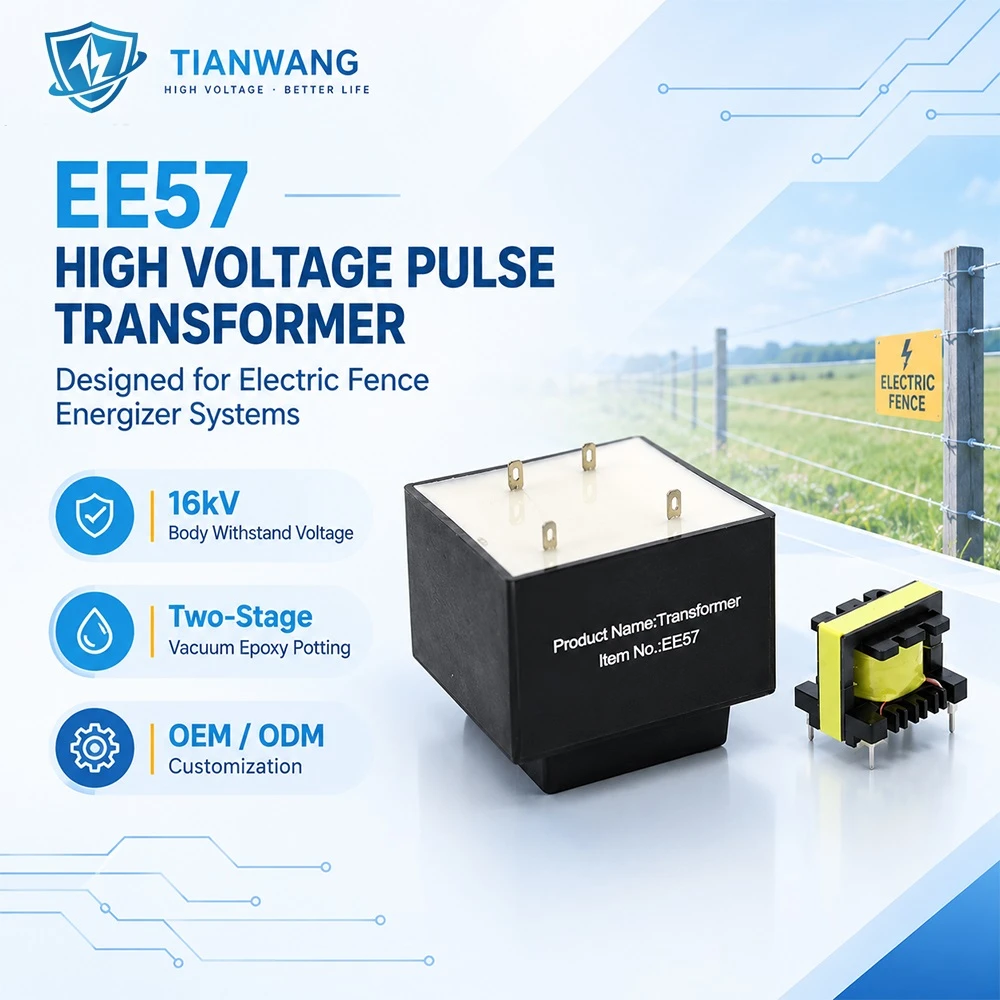
1. What Is an EE57 Electric Fence Transformer?
An electric fence transformer is a key step-up component inside an electric fence energizer. Its primary function is to convert the electrical energy supplied by the energizer circuit into high-voltage pulses that can be delivered to the fence line.
Unlike a conventional continuous-output transformer, a high voltage pulse transformer is designed to work with a pulse-driving circuit. Its electrical characteristics, winding configuration, insulation system, and compatibility with the control circuit all influence the performance of the finished energizer.
The TW-G-EE57 uses an EE57 ferrite core structure, making it suitable for electric fence energizer designs requiring a compact, customizable high-voltage transformer.
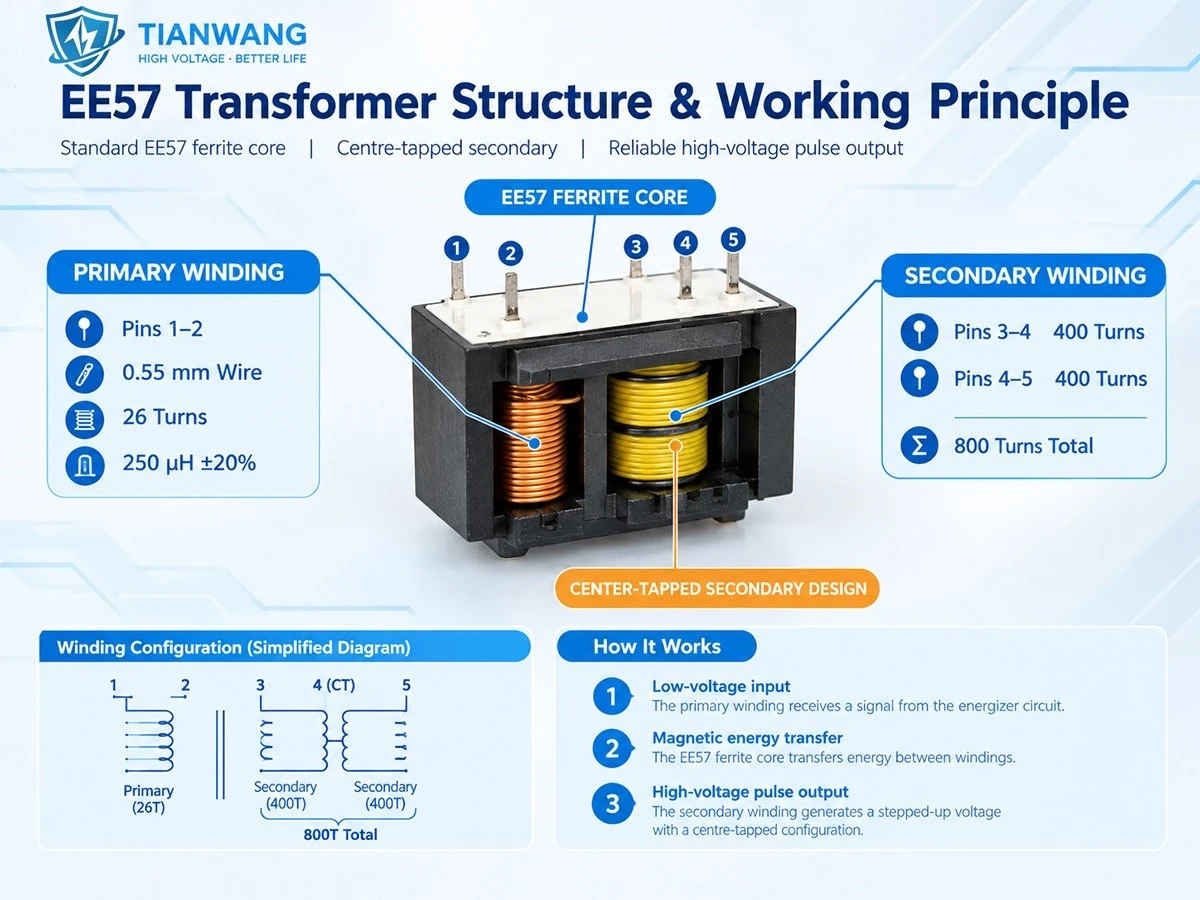
How Does an EE57 Pulse Transformer Work?
The working process can be divided into three basic stages:
Low-voltage input: The primary winding receives an electrical signal from the energizer's driving circuit.
Electromagnetic energy transfer: The EE57 ferrite core transfers magnetic energy between the primary and secondary windings.
High-voltage pulse output: The secondary winding generates a stepped-up voltage according to the circuit configuration and transformer parameters.
The final output voltage and pulse energy depend on the complete energizer circuit, including the input supply, driving circuit, transformer characteristics, and output-stage design.
Therefore, selecting the right electric fence energizer transformer requires more than checking its nominal voltage. Winding parameters, insulation performance, mechanical dimensions, and circuit compatibility should also be evaluated.
2. Key Features of the TW-G-EE57 High Voltage Pulse Transformer
The TW-G-EE57 is developed for OEM customers who need consistent electrical parameters, dependable insulation, and flexible integration into their electric fence energizer products.
2.1 Standard EE57 Ferrite Core Design
The EE57 ferrite core provides a defined magnetic circuit structure for the transformer. Its mechanical dimensions and winding configuration support integration into customer-designed energizer PCBs and enclosures.
For manufacturers with established production lines, consistent dimensions and winding parameters are important for assembly compatibility and production quality control.
2.2 Two-Stage Vacuum Epoxy Potting
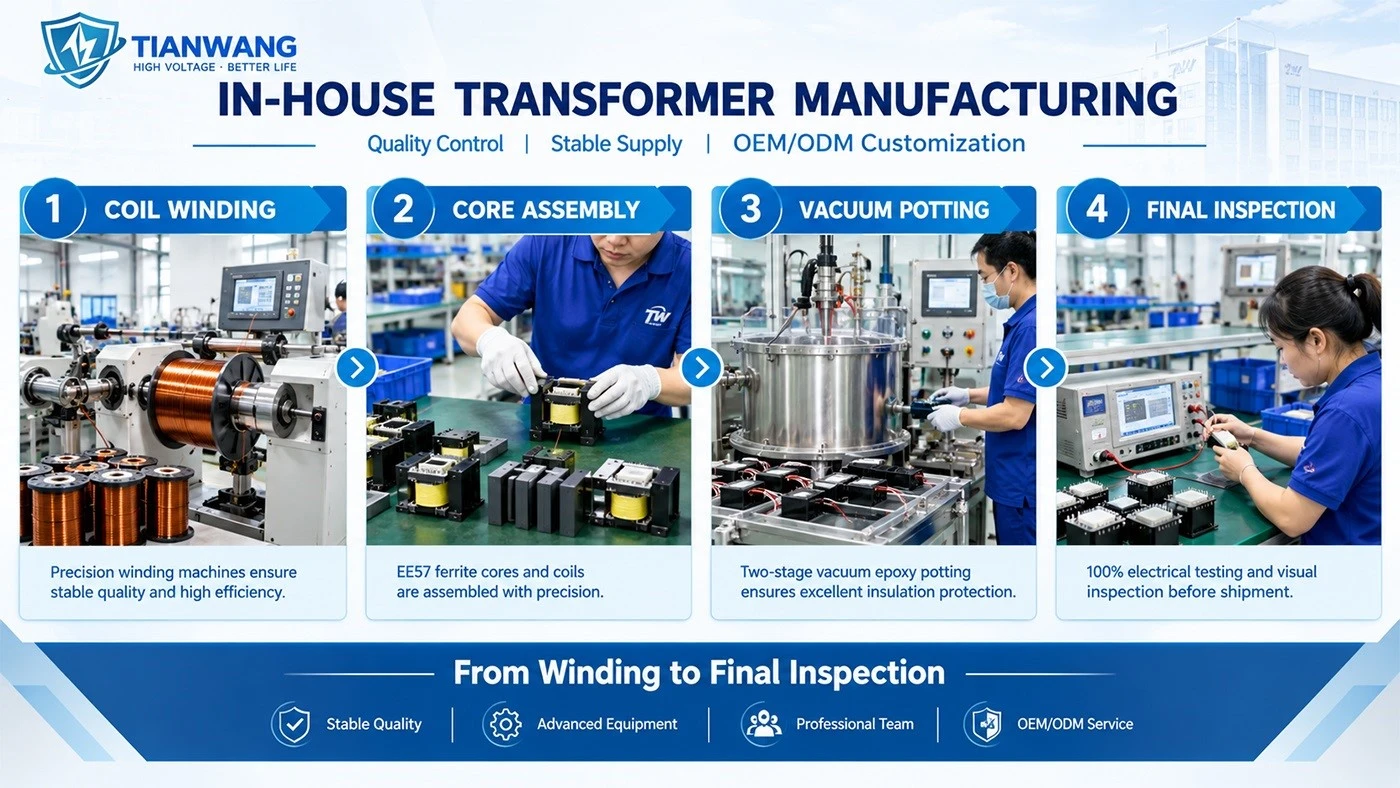
The transformer uses a two-cycle vacuum epoxy potting process to encapsulate the internal windings and core.
By applying vacuum treatment during the encapsulation process, residual air can be reduced in the winding and core areas. This helps minimize internal voids and supports improved insulation protection against moisture and environmental contamination.
Key benefits include:
Improved moisture and humidity resistance.
Reduced risk of internal air gaps and insulation defects.
Protection against dust and external contaminants.
Better mechanical stability of internal components.
Improved insulation consistency for outdoor energizer applications.
2.3 16kV Body Withstand Voltage
The finished transformer body has a rated withstand voltage of 16 kV, while the epoxy insulation material has a specified dielectric strength of 30 kV per millimeter.
These ratings provide important reference points for engineers evaluating insulation requirements and electrical safety margins in their energizer designs.
2.4 Centre-Tapped Secondary Winding
The TW-G-EE57 features a centre-tapped secondary winding with three terminals: pins 3, 4, and 5.
Each secondary section contains 400 turns, giving 800 turns across the complete secondary winding.
This winding configuration provides greater flexibility for circuit designers developing different output-stage configurations, subject to the customer's circuit design and validation.
2.5 OEM and ODM Customization
Different electric fence energizers have different electrical and mechanical requirements.
Tianwang supports customized transformer development based on customer drawings, physical samples, and project specifications.
Available customization includes input voltage, winding parameters, pulse energy requirements, terminal configuration, lead length, and housing structure.
3. TW-G-EE57 Electric Fence Transformer Specifications
The following specifications are based on Tianwang's laboratory measurements and product documentation.
3.1 Basic Product Information
| Item | Specification |
|---|---|
| Product Name | EE57 High Voltage Transformer |
| Model | TW-G-EE57 |
| Core Type | EE57 Ferrite Core |
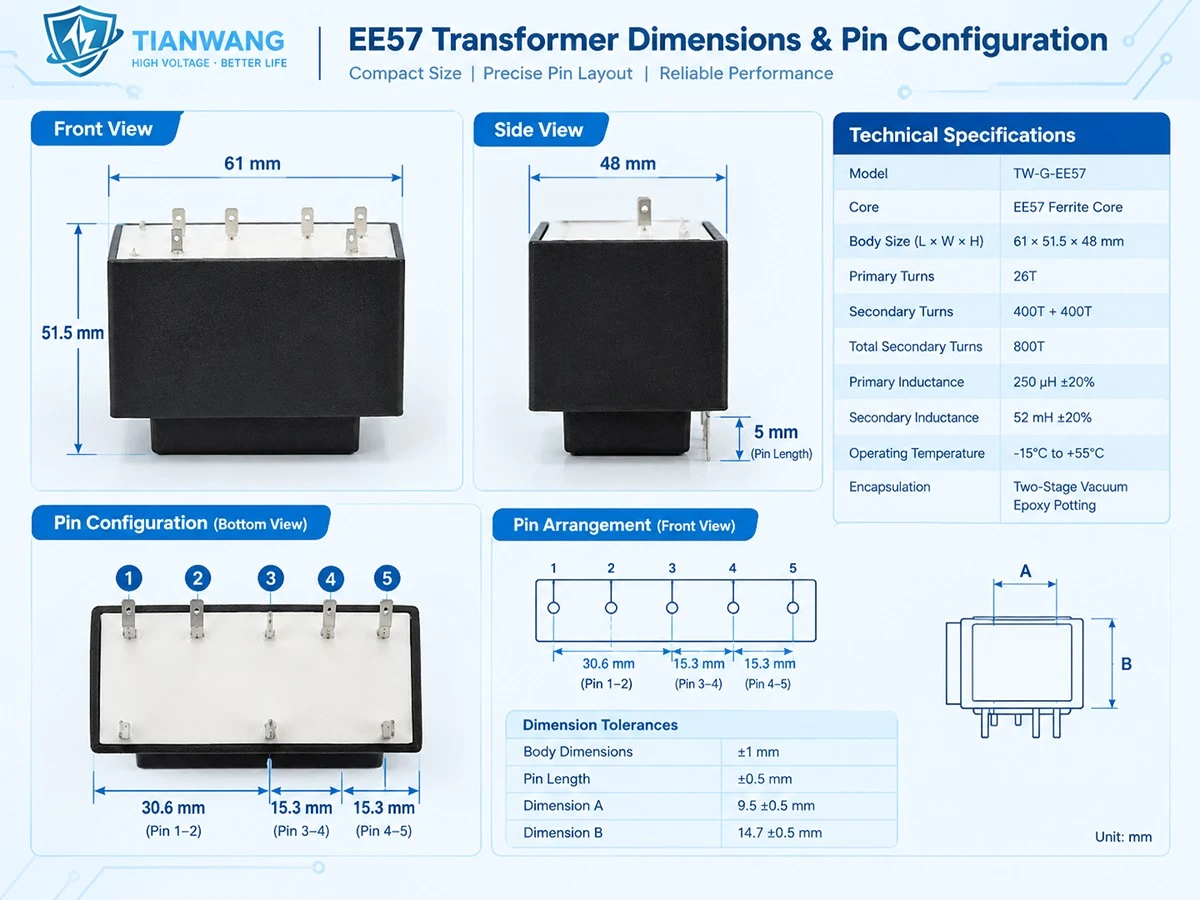
| Body Dimensions | 61 × 51.5 × 48 mm (±1 mm) |
| Pin Pitch 1–2 | 30.6 mm (±1 mm) |
| Pin Pitch 3–4 / 4–5 | 15.3 mm (±1 mm) |
| Pin Length | 5 mm (±0.5 mm) |
| Dimension A | 9.5 mm (±0.5 mm) |
| Dimension B | 14.7 mm (±0.5 mm) |
| Product Marking | Laser Marking |
| Label | Available on Request |
3.2 Winding Parameters
| Winding | Pins | Wire Diameter | Turns | Inductance | Resistance |
|---|---|---|---|---|---|
| Primary N1 | 1–2 | 0.55 mm | 26T | 250 μH ±20% | 0.15 Ω ±20% |
| Secondary N2 | 3–4 | 0.14 mm | 400T | 52 mH ±20% | 52 Ω ±20% |
| Secondary N2 | 4–5 | 0.14 mm | 400T | 52 mH ±20% | 52 Ω ±20% |
Terminal Identification:
Pins 1 and 2: Primary winding start and finish.
Pins 3, 4, and 5: Secondary winding start, centre tap, and finish.
The secondary winding consists of two 400-turn sections, providing 800 turns in total.
3.3 Environmental and Insulation Specifications
| Parameter | Specification |
|---|---|
| Encapsulation | Epoxy Resin, Two-Stage Vacuum Potting |
| Operating Temperature | -15°C to +55°C |
| Operating Humidity | 20%–80% RH |
| Atmospheric Pressure | 86–106 kPa |
| Operating Altitude | Below 3,000 m |
| Epoxy Insulation Strength | 30 kV/mm |
| Winding Wire Insulation Grade | QA-3 |
| Body Withstand Voltage | 16 kV |
Important: Output voltage, pulse energy, and input voltage are customized according to the customer's energizer circuit design. These values should be confirmed during project evaluation and sample testing.
4. Two-Stage Vacuum Epoxy Potting for Improved Insulation Protection
Insulation reliability is a critical consideration when selecting a high voltage pulse transformer for an electric fence energizer.
Transformers used in outdoor energizer systems may be exposed to temperature changes, humidity, dust, and mechanical vibration. If internal insulation is compromised, the transformer may experience electrical leakage, internal discharge, or performance instability.
To address these manufacturing challenges, the TW-G-EE57 adopts a two-stage vacuum epoxy potting process.
How Does the Vacuum Potting Process Work?
Stage 1: Initial Epoxy Encapsulation
The transformer is placed through the first vacuum epoxy potting cycle. This process helps the resin penetrate the internal winding and core areas while reducing trapped air.
Stage 2: Secondary Vacuum Treatment
A second vacuum potting cycle is performed to further reduce residual air and improve the completeness of the encapsulation.
This two-stage process helps minimize internal voids that may otherwise become weak points in the insulation system.
Why Is Vacuum Potting Important for Electric Fence Transformers?
| Manufacturing Challenge | Vacuum Potting Benefit |
|---|---|
| Internal air gaps | Helps reduce residual voids |
| High humidity | Improves encapsulation protection |
| Dust contamination | Seals internal components |
| Mechanical vibration | Helps stabilize windings and core |
| Insulation consistency | Supports more consistent dielectric performance |
Combined with the specified operating temperature range of -15°C to +55°C, the vacuum-potted design provides an insulation solution for electric fence energizer manufacturers targeting agricultural and industrial applications.
5. High Voltage Insulation Performance: 30 kV/mm and 16 kV Withstand
For a high voltage transformer manufacturer, insulation performance must be evaluated using measurable electrical parameters rather than general descriptions such as high insulation or high reliability.
The TW-G-EE57 provides three important insulation-related specifications:
| Performance Metric | Rating | Technical Significance |
|---|---|---|
| Epoxy Insulation Strength | 30 kV/mm | Specified dielectric strength of the epoxy material |
| Wire Insulation Grade | QA-3 | Insulation grade of the winding wire |
| Body Withstand Voltage | 16 kV | Rated withstand capability of the finished transformer body |
These parameters help OEM engineers evaluate the transformer during circuit development, component selection, and product validation.
It is important to distinguish between material dielectric strength and finished-product withstand voltage. The 30 kV/mm rating refers to the epoxy insulation material, while 16 kV refers to the specified withstand voltage of the complete transformer body.
The two figures describe different performance characteristics and should not be treated as interchangeable ratings.
6. 100% Outgoing Inspection and Quality Control
Consistent product quality is essential for electric fence energizer manufacturers purchasing transformers in volume.
Tianwang applies an outgoing inspection procedure to every TW-G-EE57 unit before shipment, covering visual inspection, electrical parameter testing, and dielectric withstand testing.
6.1 Visual Inspection
Each transformer is checked for:
Clean housing and potting surfaces.
No visible oil residue, excessive bubbles, or burrs.
No housing distortion or deformation.
No damaged, bent, or contaminated pins.
Correct terminal pitch and alignment.
A pin gauge fixture is used to check the mechanical positioning of the terminals.
6.2 Electrical Performance Testing
An LCR bridge meter (GF100LA) is used to measure inductance and resistance.
The inspection limits are established according to each winding specification.
| Winding | Inductance Acceptance Range | Resistance Acceptance Range |
|---|---|---|
| N1 (1–2) | 200–300 μH | 0.12–0.18 Ω |
| N2 (3–4) | 41.6–62.4 mH | 41.6–62.4 Ω |
| N2 (4–5) | 41.6–62.4 mH | 41.6–62.4 Ω |
Each winding section is measured using a dedicated test fixture.
Units outside the specified acceptance limits are rejected.
6.3 Dielectric Withstand (Hi-Pot) Testing
A dielectric withstand test is performed to evaluate the insulation performance of the finished transformer.
The procedure includes:
Checking the test environment and equipment condition.
Setting the specified test voltage and leakage current limits.
Checking the overcurrent protection and breakdown signal.
Connecting the test clips to the specified winding terminals.
Gradually increasing the voltage to the target level.
Holding the specified voltage for one minute.
Checking for continuous flashover or insulation breakdown.
Products that fail the specified withstand requirements are rejected.
Through these three inspection stages, Tianwang establishes a consistent quality-control process for the TW-G-EE57 before shipment.
7. OEM/ODM Electric Fence Transformer Customization
Not every electric fence energizer uses the same circuit architecture.
Different applications may require different input voltages, output characteristics, winding configurations, and installation dimensions.
As an experienced electric fence transformer manufacturer, Tianwang provides OEM and ODM development services to match customer-specific electrical and mechanical requirements.
Five Key Customization Options
1. Input Voltage
Transformer development can be matched to different energizer power architectures, including mains-powered, battery-powered, and solar-compatible systems, subject to the customer's circuit requirements.
2. Output Voltage and Pulse Energy
Output voltage and pulse energy are defined according to the customer's energizer circuit, required output characteristics, and application.
3. Winding Parameters
Custom winding development may include:
Primary and secondary turns.
Wire diameter.
Inductance.
Resistance.
Winding configuration.
4. Lead Length and Terminal Configuration
Terminal positions, lead lengths, and connection structures can be adjusted to fit the customer's PCB layout and assembly requirements.
5. Housing Structure and Mechanical Dimensions
The transformer housing and external dimensions can be adapted to the customer's enclosure and installation space.
Drawing-Based and Sample-Based Development
Tianwang supports two main development approaches:
Drawing-based customization: Customers provide technical drawings and electrical specifications.
Sample-based customization: Customers provide an existing transformer sample for evaluation and development.
Engineering support is also available during the customer's energizer system debugging and validation process.
OEM branding is supported for customers developing their own electric fence energizer product lines.
8. Two Supply Solutions: Transformer Components or Complete Energizers
Different customers have different production capabilities and sourcing requirements.
To support both component manufacturers and finished-product distributors, Tianwang offers two supply models.
| Supply Model | Suitable Customers | Main Advantages |
|---|---|---|
| TW-G-EE57 Transformer Component | Electric fence energizer manufacturers | Component sourcing, in-house assembly, customized integration |
| Complete Electric Fence Energizer | Wholesalers, distributors, contractors, and system integrators | Ready-to-install products, simplified sourcing, reduced assembly requirements |
Standalone Electric Fence Transformer Supply
For customers with their own PCB design and assembly facilities, Tianwang supplies the TW-G-EE57 as an independent high-voltage transformer component.
This allows customers to retain control over their energizer circuit design and finished-product manufacturing.
Complete Electric Fence Energizer Supply
For customers who prefer finished products, Tianwang also provides complete pulse electric fence energizer units.
This model is suitable for distributors, wholesalers, agricultural suppliers, and project contractors who need finished equipment rather than individual electronic components.
Both supply options are supported by the same manufacturing and quality-control system.
9. Applications of the TW-G-EE57 High Voltage Pulse Transformer
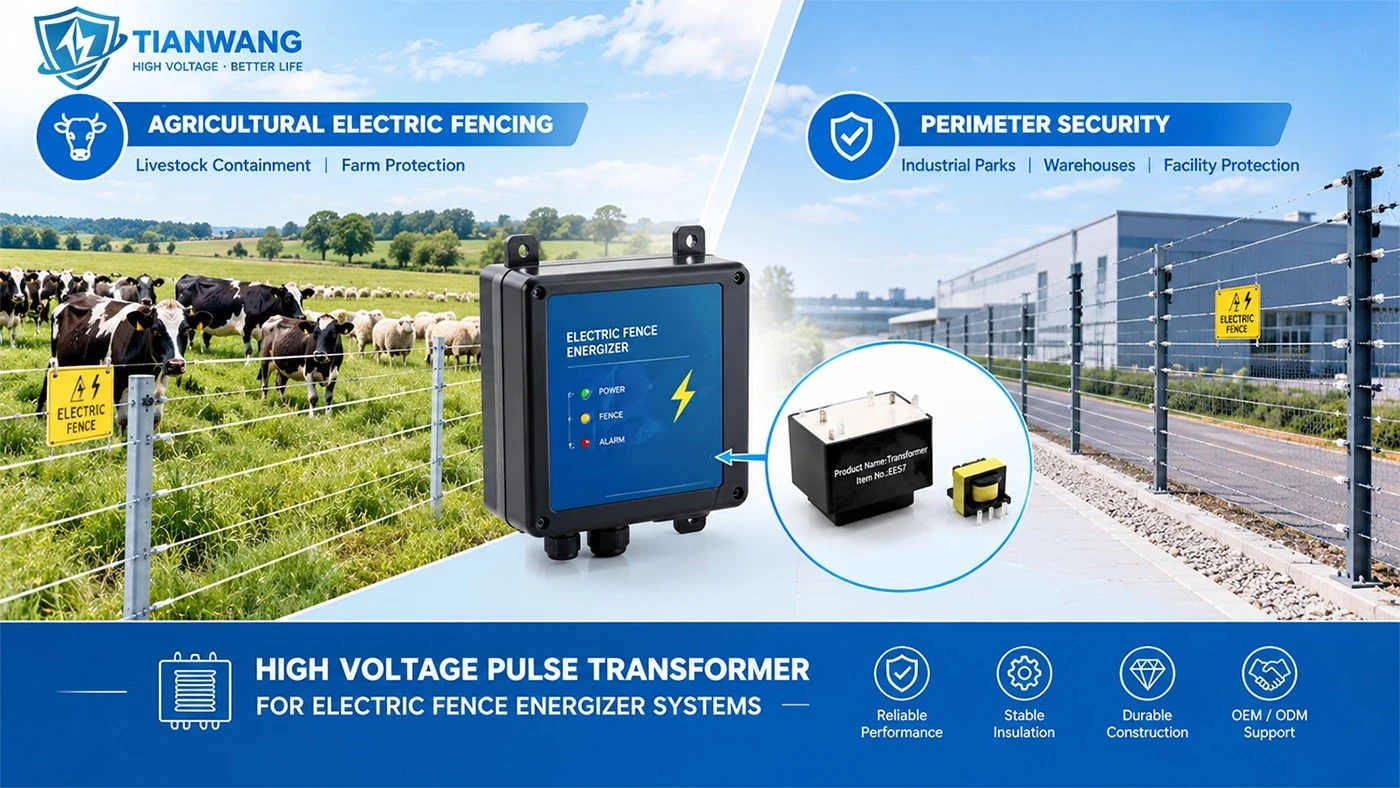
The TW-G-EE57 is designed for integration into pulse electric fence energizer systems. Its final application depends on the customer's circuit design, system configuration, and product validation.
Typical application markets include:
9.1 Perimeter Security Systems
Electric fence energizers are used in perimeter protection systems for:
Industrial parks and factories.
Warehouses and logistics facilities.
Residential and commercial properties.
Power stations and substations.
Communication and water treatment facilities.
9.2 Agricultural and Livestock Electric Fencing
Electric fence systems help farmers manage livestock movement and protect designated areas.
Typical applications include:
Cattle and sheep containment.
Goat, horse, and pig enclosures.
Rotational grazing systems.
Pasture management.
Crop and orchard protection against wildlife intrusion.
9.3 Multi-Zone Electric Fence Energizer Designs
The centre-tapped secondary winding offers additional configuration possibilities for engineers designing energizer circuits with different output-stage requirements.
The actual output configuration must be determined by the complete circuit design and validated under the intended operating conditions.
10. How to Choose a Reliable Electric Fence Transformer Manufacturer
Choosing the right electric fence transformer supplier involves more than comparing unit prices.
For OEM customers and energizer manufacturers, the following six factors should be evaluated before placing a volume order.
1. Winding Parameter Consistency
Check inductance, resistance, wire diameter, and winding turns. Ask for defined tolerances and production inspection records.
2. Vacuum Potting Quality
Confirm whether the transformer uses vacuum epoxy potting and understand the number of encapsulation cycles.
This is particularly important for applications in humid agricultural and outdoor environments.
3. High Voltage Insulation Ratings
Evaluate epoxy dielectric strength, winding wire insulation grade, and finished-product withstand voltage.
Make sure these specifications are clearly distinguished.
4. Mechanical Dimensions and Pin Accuracy
Check body dimensions, pin pitch, pin length, and terminal configuration to avoid compatibility problems during PCB assembly.
5. Quality Inspection Procedures
Ask whether each transformer is inspected or only sampled.
Confirm whether electrical parameter testing and hi-pot testing are included in the outgoing inspection process.
6. OEM/ODM Engineering Support
For customized energizer projects, choose a supplier that can work from drawings or physical samples and support engineering evaluation during product development.
A manufacturer with in-house winding, potting, assembly, and inspection capabilities can provide better coordination across the component development and production process.
11. Frequently Asked Questions About Electric Fence Transformers
Q1: What does an electric fence transformer do?
An electric fence transformer is a high-voltage step-up component inside an electric fence energizer. It works with the energizer's driving circuit to convert electrical energy into high-voltage pulses delivered to the fence line.
Q2: What is an EE57 high voltage transformer?
EE57 refers to the ferrite core geometry and size designation used in the transformer. The EE57 structure provides a defined magnetic circuit and mechanical configuration for transformer manufacturing and energizer integration.
Q3: What is the body size of the TW-G-EE57 transformer?
The TW-G-EE57 measures 61 × 51.5 × 48 mm (±1 mm). Its pin pitch is 30.6 mm between pins 1–2 and 15.3 mm between pins 3–4 or 4–5.
Q4: What are the winding specifications of the EE57 transformer?
The primary winding uses 0.55 mm wire with 26 turns, 250 μH ±20% inductance, and 0.15 Ω ±20% resistance.
The centre-tapped secondary winding uses 0.14 mm wire. Each section has 400 turns, 52 mH ±20% inductance, and 52 Ω ±20% resistance.
Q5: What is the withstand voltage of the TW-G-EE57?
The finished transformer body has a specified withstand voltage of 16 kV. Its epoxy insulation strength is rated at 30 kV/mm, and the winding wire uses QA-3 insulation grade.
Q6: Why does the electric fence transformer use vacuum epoxy potting?
Vacuum epoxy potting helps reduce internal air voids and improves encapsulation of the windings and core. This supports better insulation protection against humidity, dust, and environmental contamination.
Q7: What is the operating temperature range?
The specified operating temperature range is -15°C to +55°C, with an operating humidity range of 20%–80% RH and an altitude below 3,000 meters.
Q8: Can the output voltage and pulse energy be customized?
Yes. Output voltage and pulse energy are defined according to the customer's energizer circuit design. Tianwang also supports customization of input voltage, winding parameters, terminal configuration, and housing structure.
Q9: Does Tianwang provide OEM and ODM electric fence transformers?
Yes. OEM and ODM services include customized winding specifications, mechanical structures, and development based on customer drawings or physical samples.
Q10: Can I purchase only the transformer without a complete energizer?
Yes. Tianwang supplies the TW-G-EE57 as a standalone transformer component. Complete electric fence energizer units are also available.
Q11: Does Tianwang test every transformer before shipment?
Yes. Each unit undergoes visual inspection, inductance and resistance testing, and dielectric withstand testing according to the specified inspection procedure.
Q12: What certifications does the EE57 series have?
The EE57 series carries CE and RoHS certification according to the product documentation. Additional certification and testing requirements can be discussed for specific projects.
Q13: How is the TW-G-EE57 packaged?
The standard packaging uses corrugated cartons with internal foam board protection and layered separation.
Each carton contains 100 pieces and measures 385 × 280 × 360 mm.
12. Why Choose Tianwang as Your Electric Fence Transformer Manufacturer?
Jiangsu Tianwang Solar Technology Co., Ltd. specializes in the research, development, and manufacturing of electric fence transformers, high voltage pulse generators, and other high-voltage electronic products.
With in-house manufacturing capabilities, Tianwang provides an integrated production process covering:
Mould development and enclosure injection moulding.
Transformer bobbin winding.
Vacuum epoxy potting.
Component assembly.
Electrical performance testing.
Final quality inspection.
This integrated manufacturing structure supports factory-direct supply of transformer components and complete electric fence energizer products.
For international OEM and ODM customers, Tianwang provides:
Customized transformer development.
Drawing-based and sample-based engineering.
OEM branding.
ODM electrical and mechanical customization.
Component and finished-product supply.
Quality inspection and production coordination.
The TW-G-EE57 is part of Tianwang's high-voltage transformer product range, developed to support customers looking for a customizable EE57 electric fence energizer transformer.
Request a Quote for Your EE57 Electric Fence Transformer Project
Looking for a reliable electric fence transformer manufacturer for your next energizer project?
Whether you need a standard TW-G-EE57 high voltage pulse transformer or a customized transformer solution, Tianwang can work with your engineering and purchasing teams to evaluate your requirements.
Send us your technical drawings, existing transformer samples, or project specifications.
Contact Jiangsu Tianwang Solar Technology Co., Ltd.
Email: fgd@twgdmall.com
WhatsApp: +86 18914538460
Website: https://www.tw-highvoltagegenerator.com
TW-G-EE57 – Custom Electric Fence Transformers for OEM/ODM Energizer Manufacturer