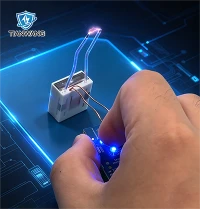
1: Product Specifications & Basics
| Feature | Details |
| Input Voltage | 110V / 220V (Customizable for 12V / 24V DC) |
| Output Cable Length | 1.8 Meters |
| Voltage Specs | 2kV, 3kV (Standard), 5kV, 8kV |
| Emission Plate Size | 300x300mm, 350x500mm |
| Material | Ultra-thin super-insulating material with internal conductive adhesive strips |

2: Core Technology & Working Principles
Q1: What is the principle behind Electrostatic Food Preservation?
Answer: It utilizes a high-voltage electrostatic field to induce water molecule resonance. This reduces the freezing point of food (e.g., preventing ice formation at 0°C to -5°C). By maintaining a non-freezing, supercooled state, the technology prevents cellular damage from sharp ice crystals, thereby keeping food fresh without freezing injuries.
Q2: Why are Emission Plates more effective than Emission Rods?
Answer: While both can generate field strength, the Emission Plate offers superior electrical field penetration for specific products. Emission Rods often have higher internal loads and thick insulating plastic shells, which consume most of the energy, leading to weaker actual performance on the food products.
Q3: Is the system AC or DC?
Answer: It uses AC (Alternating Current). A changing electric field direction is essential to trigger the resonance of water molecules. DC (Direct Current) is unidirectional and cannot achieve this vibrating effect.
3: Professional Applications
Q4: What is the recommended voltage for meat preservation?
Answer: Based on experimental data, 2500V to 3000V is the optimal range for meat to achieve the best freshness-retention results.
Q5: When is the best time to install/activate the system during freezing?
Answer: It should be used during the transition from fresh to frozen state. The electrostatic field ensures that ice crystals formed during the cooling process are rounded and small rather than sharp and jagged. Once the meat is completely frozen solid, the impact is significantly reduced.
Q6: Can it solve the "blood water" (drip loss) problem during thawing?
Answer: Yes. While some fluid loss is natural, using electrostatic preservation significantly reduces drip loss (blood water) by protecting the integrity of cell membranes during storage.
Q7: What is the coverage area for one module and one plate?
Answer: One standard module combined with one emission plate can cover a volume of approximately 25m³.
For product inquiries, OEM/ODM cooperation, or distribution opportunities, please contact our sales team.
Email: alice@twgdsolar.com
WhatsApp/WeChat/Mobile: +86-15261031116