As livestock farming moves toward smarter, more digital, and more precise management, traditional physical fencing is facing new challenges. Building fixed fences requires posts, wires, labor, installation time, and ongoing maintenance. For large ranches, complex terrain, rotational grazing, and remote pasture management, traditional fencing can quickly become costly and inflexible.
This is why smart sheep and cattle collars with virtual fencing systems are gaining attention from ranch owners, livestock equipment manufacturers, and smart agriculture solution providers.
By combining GPS positioning, wireless communication, audio warning, and short controlled pulse feedback, livestock can be guided within a designated grazing area without relying completely on physical fences.
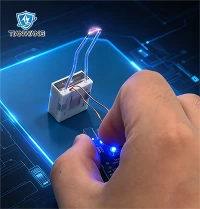
Inside this system, one of the key components that determines whether the collar can deliver stable, safe, low-power, and reliable feedback is the DC High-Voltage Module for Smart Sheep and Cattle Collars.
Customers Do Not Simply Care About "High Voltage" - They Care About Control, Safety, and Stability
For smart ranch customers, the value of a high-voltage module is not about how high the voltage can be. What really matters is whether the module can provide feedback at the right time, in a safe, short, and controlled way.
In a virtual fencing system, when an animal approaches the boundary, the collar usually gives an audio warning first. If the animal continues moving forward or crosses the virtual boundary, the system then activates the high-voltage module. The module converts low-voltage battery power into a short pulse, which is delivered through the electrodes as a mild stimulation signal. Over time, the animal learns to respond to the warning and return to the safe area.
This means the high-voltage module must meet several important requirements:
It should not output continuously, but provide short pulse feedback only when needed.
It should not focus on strong stimulation, but on low-current and controlled output.
It should not work alone, but cooperate with GPS, MCU, audio warning, and wireless communication modules.
It should not be treated as a simple disposable component, but as a reliable part designed for long-term outdoor use.
For collar manufacturers, a stable high-voltage module directly affects product safety, animal welfare, battery life, user experience, and after-sales reliability.

Why Smart Sheep and Cattle Collars Need Customized High-Voltage Modules
Unlike ordinary high-voltage generators, smart livestock collars are used in much more demanding environments.
Sheep and cattle stay outdoors for long periods. Their collars may be exposed to rain, mud, sweat, vibration, friction, temperature changes, and impact. At the same time, the collar must remain lightweight and comfortable enough not to affect the animal's feeding, walking, or resting.
That is why customers usually pay close attention to the following points when selecting a high-voltage module.
1. Is the Module Compact Enough to Fit Inside the Collar Housing?
A smart collar has limited internal space.
In addition to the high-voltage module, the collar may also need to contain a battery, GPS module, wireless communication module, MCU control board, buzzer, antenna, electrodes, and structural components.
If the high-voltage module is too large, it may increase the collar's weight, affect the internal layout, and reduce wearing comfort for the animal.
Jiangsu Tianwang Solar Technology Co., Ltd. provides high-voltage modules for smart sheep and cattle collars that can be customized according to the customer's collar structure, voltage requirements, power needs, dimensions, and connection methods.
These modules are suitable for:
Virtual fence collars;
GPS livestock tracking collars;
Smart sheep management collars;
Cattle grazing control collars;
Smart ranch management equipment.
For equipment manufacturers, this means easier integration and greater flexibility during product development.
2. Is the Output Stable Enough to Avoid Being Too Weak or Too Strong?
In real grazing environments, if the output is too weak, animals may ignore the stimulation and the virtual fencing effect will be reduced. If the output is too strong, it may raise concerns related to safety, animal welfare, and user acceptance.
Therefore, a qualified high-voltage module must provide stable, short-duration, current-limited pulse output.
Its purpose is not to deliver continuous electric shock. Instead, it provides clear but controlled behavioral feedback when the animal does not respond to the audio warning.
This design better matches the modern livestock industry's demand for gentle management, animal-friendly technology, and reliable training feedback.
3. Is the Power Consumption Low Enough for Long-Term Outdoor Use?
Battery life is one of the most important concerns for smart livestock collar users.
Ranchers do not want to frequently remove collars for charging or battery replacement, especially when managing large herds across wide pastures.
Smart sheep and cattle collars are usually powered by low-voltage batteries such as 3V, 3.6V, 3.8V, or 5V. The high-voltage module must remain in a low-power state during standby, respond quickly when pulse feedback is required, and then return to low-power operation immediately after output.
This low-power design helps smart collar manufacturers improve battery life, reduce maintenance frequency, and create a better user experience for ranch owners.

Virtual Fencing Helps Customers Reduce Long-Term Fencing Costs
Traditional ranch fencing requires posts, wires, manual installation, land preparation, and regular maintenance. For large-scale farms or complex terrain, the construction and maintenance costs can be significant.
Traditional fencing also lacks flexibility. When ranchers need rotational grazing, temporary zoning, or seasonal pasture adjustment, changing physical fences can be time-consuming and labor-intensive.
Virtual fencing allows grazing boundaries to be set and adjusted through smart collars and software systems. Ranchers can manage grazing areas based on grass growth, animal numbers, weather conditions, and feeding plans.
From the customer's perspective, the value of virtual fencing mainly includes:
| Customer Concern | Traditional Physical Fence | Virtual Fence Collar |
|---|---|---|
| Initial construction | Requires posts, wires, and labor | Reduces dependence on physical fencing |
| Boundary adjustment | Difficult and time-consuming | Can be adjusted more flexibly through software |
| Large ranch management | High cost and difficult maintenance | Better suited for remote management |
| Rotational grazing | Requires manual fencing changes | Supports dynamic grazing area settings |
| Animal behavior management | Relies on physical blocking | Uses audio warning and pulse feedback training |
In this system, the high-voltage module may be only one internal component of the collar, but it plays a critical role in making the feedback function reliable and practical.

Applications: Not Only for Sheep Collars, But Also for Cattle and Smart Ranch Systems
The DC high-voltage module can be widely used in smart livestock and ranch management products, including:
Smart sheep collars;
Smart cattle collars;
GPS livestock tracking collars;
Virtual fence collars;
Livestock behavior training devices;
Smart ranch management systems;
Cattle and sheep grazing area control equipment;
Livestock IoT terminal devices.
For equipment manufacturers, the module can work as a core functional unit together with GPS, MCU, wireless communication, and audio warning systems to form a complete smart collar solution.
For Equipment Manufacturers, Customization Matters More Than a Standard Module
Smart collar projects are rarely solved by using one standard module for every product.
Different customers may have different product structures, battery solutions, animal types, stimulation levels, housing dimensions, operating environments, and target markets.
That is why high-voltage module suppliers need strong OEM and ODM customization capabilities.
Jiangsu Tianwang Solar Technology Co., Ltd. can provide customized support for:
Input voltage, such as 3V, 3.6V, 3.8V, 5V, and other requirements;
Output voltage and pulse intensity;
Module size and shape;
Lead wires, connectors, and installation methods;
Sheep collar, cattle collar, and other livestock collar applications;
Sample development and mass production support.
For customers developing virtual fence collars, this customization capability can help shorten the R&D cycle, reduce integration difficulty, and improve time-to-market efficiency.
High-Voltage Modules Are Becoming a Key Component in Smart Ranch Equipment Upgrades
The future of ranch management will no longer depend only on fences, manual patrols, and traditional experience. More livestock operations are moving toward data-driven management, positioning technology, remote control, and intelligent hardware.
The core value of a virtual fence collar is to make pasture boundaries more flexible.
The core value of the high-voltage module is to make boundary feedback safe, stable, controllable, and executable.
For smart livestock equipment manufacturers, virtual fencing system integrators, and smart agriculture solution providers, choosing a reliable, low-power, and customizable high-voltage module is not just about selecting an electronic component.
It is about helping end users build a more efficient, flexible, and manageable ranching system.
Conclusion
Jiangsu Tianwang Solar Technology Co., Ltd. focuses on the development and production of high-voltage electronic modules and high-voltage generators.
For smart sheep collars, cattle collars, virtual fencing systems, GPS livestock management devices, and other smart ranch applications, we provide stable and customizable DC high-voltage module solutions.
If you are developing a smart sheep collar, cattle collar, virtual fence device, or intelligent ranch management system, we can customize the module according to your input voltage, output requirements, product size, and application scenario.
Contact us to get a customized high-voltage module solution for your smart livestock collar project.