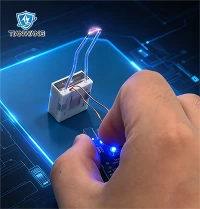
High Voltage Electrostatic Seafood Preservation System for Shrimp, Crab and Fresh Seafood

1. Improve Seafood Freshness with Electrostatic Preservation Technology
Fresh seafood is highly perishable. Shrimp, swimming crabs, fish, and other aquatic products are particularly sensitive to temperature fluctuations, microbial growth, moisture loss, and storage conditions.
Traditional seafood preservation mainly relies on refrigeration and freezing. However, conventional cold storage may cause quality deterioration, moisture loss, texture changes, or freezing damage when temperature conditions are not properly controlled.
To address these challenges, Jiangsu Tianwang Solar Technology Co., Ltd. has developed the TW-G-JD-06 High Voltage Electrostatic Food Preservation Module, designed for integration into seafood cold storage rooms, commercial seafood refrigerators, and aquatic product preservation equipment.
By combining an approximately 8,000V high-voltage generator with electrostatic emitter plates or rods, the system establishes an electrostatic field within the storage environment.
This technology provides an additional physical preservation approach alongside conventional refrigeration, helping seafood businesses improve storage management, reduce product losses, and maintain product quality.
2. How Does Electrostatic Seafood Preservation Work?
The TW-G-JD-06 module converts AC 220V input into an approximately 8,000V secondary high-voltage output.
When connected to specially designed emitter plates or emitter rods, it creates an electrostatic field throughout the refrigeration space.
The system is designed to support seafood preservation through several potential mechanisms:
Freezing damage management: The electrostatic environment is intended to influence water behavior and ice crystal formation in food tissues under suitable sub-zero storage conditions.
Freshness management: It may help slow quality deterioration associated with moisture loss and oxidation.
Storage environment optimization: The electrostatic field provides an additional physical treatment approach without direct contact between the emitter and seafood.
The system must operate together with appropriate refrigeration, temperature control, and seafood hygiene management. It does not replace conventional refrigeration or established food safety procedures.
3. Key Seafood Applications
3.1 Shrimp Preservation
Shrimp are highly perishable aquatic products. During storage and transportation, they can experience discoloration, texture deterioration, moisture loss, and microbial spoilage.
The electrostatic food preservation system is designed for integration into shrimp cold storage rooms and commercial seafood preservation cabinets.
Potential application objectives include:
Helping maintain shrimp freshness during refrigerated storage.
Reducing quality deterioration associated with moisture loss.
Supporting more stable storage conditions.
Helping reduce post-harvest product losses.
Suitable for shrimp processing plants, seafood wholesalers, aquaculture businesses, and refrigerated distribution facilities.
3.2 Swimming Crab and Fresh Crab Preservation
Swimming crabs, including Portunus trituberculatus, are valuable seafood products with demanding storage requirements.
Crab meat quality can deteriorate rapidly if temperature and storage conditions are not properly managed.
The TW-G-JD-06 electrostatic module can be integrated into crab storage cabinets and refrigerated seafood warehouses.
Its application is designed to support:
Freshness management during refrigerated storage.
Reduction of quality deterioration.
Improved storage environment management.
Integration into commercial crab preservation equipment.
For live crabs, appropriate oxygen supply, humidity, water quality, and species-specific temperature management remain essential. Electrostatic preservation is not a substitute for live seafood care.
3.3 Fish and Other Aquatic Products
In addition to shrimp and crabs, the system can be considered for refrigerated storage applications involving:
Fresh marine fish.
Freshwater fish.
Squid and cuttlefish.
Shellfish.
Other fresh aquatic products.
Different seafood products have different storage requirements. The appropriate operating temperature and emitter configuration should be evaluated according to the product type and storage process.

4. Four Advantages for Seafood Cold Storage
1. Support Freshness at Controlled Low Temperatures
The system is designed to work with refrigeration equipment in suitable low-temperature environments.
Its application target includes reducing freezing-related quality damage while supporting longer refrigerated storage periods.
A proposed operating temperature range is approximately +5°C to -5°C, subject to seafood species, product condition, packaging, and validated storage tests.
2. Potential Reduction in Refrigeration Energy Consumption
By providing an additional preservation approach, the system may help optimize refrigeration operation in suitable applications.
The targeted energy-saving potential is 30–50%, depending on cold storage insulation, compressor performance, loading conditions, and operating temperature.
Actual savings must be confirmed through before-and-after energy consumption measurements.
3. Physical Preservation Without Chemical Additives
The electrostatic treatment uses a physical electric field.
No chemical preservatives required by the electrostatic treatment itself.
No direct contact between emitters and seafood.
No additional chemical preservation coating.
Suitable for integration into existing seafood refrigeration systems.
Food safety and hygiene requirements must still be maintained throughout storage and transportation.
4. Retrofit Existing Seafood Cold Storage Equipment
The TW-G-JD-06 module can be integrated into existing refrigeration equipment without requiring complete replacement of the original cooling system.
Typical applications include seafood cold storage rooms, shrimp processing facilities, crab storage cabinets, seafood display refrigerators, and aquatic product distribution centers.
5. Emitter Plate or Emitter Rod for Seafood Storage?
Different seafood storage spaces require different electrostatic emitter configurations.
| Emitter Type | Recommended Application | Main Feature |
|---|---|---|
| Emitter Plate | Small seafood cabinets and cold storage up to approximately 20 m³ | Designed for relatively uniform electric field distribution |
| Emitter Rod | Medium and large seafood warehouses and processing facilities | Suitable for larger spaces and densely arranged storage goods |
The final configuration should be selected according to storage volume, seafood arrangement, installation location, and electric field distribution requirements.
6. TW-G-JD-06 High Voltage Electrostatic Module Specifications
| Parameter | Specification |
|---|---|
| Model | TW-G-JD-06 |
| Application | Electrostatic Seafood Preservation |
| Input Voltage | AC 220V |
| Secondary Output | Approximately 8,000V |
| Dimensions | 135 × 75 × 50 mm |
| Dimensional Tolerance | ±0.15 mm |
| Magnetic Core | E-Type Silicon Steel |
| Cooling Method | Natural Air Cooling |
| Insulation Class | Class B, 130°C |
| Insulation Resistance | ≥100 MΩ |
| Insulation Voltage | ≥4 kVrms |
| Operating Temperature | -20°C to +105°C |
| Applicable Altitude | 0–2,000 m |
| Standard Protection | IP20 |
| Optional Protection | IP54 |
| Emitter Options | Emitter Plate / Emitter Rod |
The module features a compact structure, natural air cooling, and flexible installation options, making it suitable for integration into seafood preservation equipment.
7. OEM/ODM Solutions for Seafood Refrigeration Equipment Manufacturers
Jiangsu Tianwang Solar Technology Co., Ltd. provides high-voltage electrostatic modules for industrial and commercial refrigeration applications.
We support OEM/ODM cooperation for:
Seafood preservation cabinets.
Shrimp and crab cold storage equipment.
Commercial seafood display refrigerators.
Aquatic product processing equipment.
Industrial cold storage systems.
Refrigerated food distribution equipment.
Customization options include electrical specifications, module dimensions, emitter configurations, wiring, and enclosure protection requirements.
From sample development to mass production, we work with equipment manufacturers to develop suitable electrostatic preservation solutions.
8. Frequently Asked Questions
Q1: Can the TW-G-JD-06 module be used for shrimp preservation?
Yes. It is designed for integration into shrimp refrigeration and cold storage equipment as an additional physical preservation technology.
Q2: Is it suitable for swimming crab preservation?
Yes. It can be integrated into refrigerated crab storage cabinets and seafood cold storage facilities. Live crab storage still requires appropriate species-specific environmental management.
Q3: Does electrostatic preservation replace seafood refrigeration?
No. The system works alongside conventional refrigeration. Proper temperature control, hygiene, and cold chain management remain essential.
Q4: What is the output voltage?
The module uses AC 220V input and provides an approximately 8,000V secondary output.
Q5: Can it be installed in an existing seafood cold storage room?
Yes. It is designed for retrofit applications. The emitter configuration and electrical installation should be evaluated according to the storage environment.
Q6: Can the module be customized for seafood refrigeration equipment?
Yes. OEM/ODM customization is available for electrical specifications, dimensions, emitter configurations, and equipment integration.
9. Contact Tianwang for Electrostatic Seafood Preservation Solutions
Looking for a high voltage electrostatic seafood preservation generator for shrimp, swimming crabs, fresh fish, or other aquatic products?
The TW-G-JD-06 module provides a compact high-voltage solution for seafood cold storage equipment, commercial refrigeration cabinets, and industrial aquatic product preservation systems.
Contact Jiangsu Tianwang Solar Technology Co., Ltd. to discuss your seafood preservation project, request technical specifications, and explore OEM/ODM cooperation.
Model: TW-G-JD-06
Input: AC 220V
Secondary Output: Approximately 8,000V
Applications: Shrimp / Swimming Crab / Fish / Seafood Cold Storage
Customization: OEM & ODM Available